By Mark Yegge
AI in Plain English: 40 Words Every Business Owner Hears (and What They Actually Mean)
Every sales call now sounds like a secret language. This page translates the terms you actually hear - each one in plain words, plus what it means for your company.
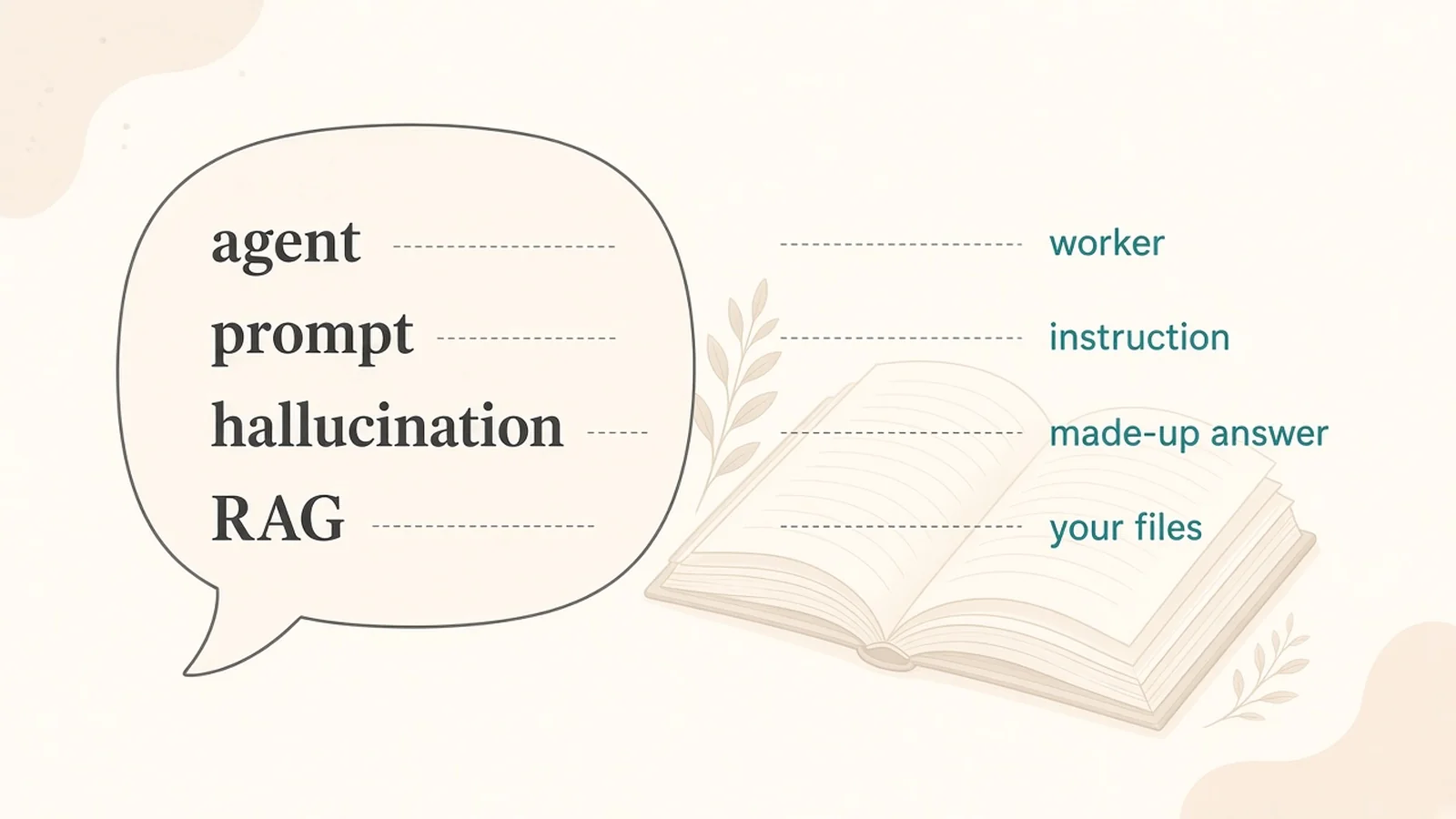
Your vendors throw around terms like agents, RAG, and fine-tuning like everyone should already know them. The articles you skim assume you do. So you nod along, and then you buy the wrong thing - or you buy nothing and hope it all goes away.
Here is the thing I have learned building with AI for the last couple of years: almost all of this jargon is simpler than it sounds once somebody says it in plain words. That is what this page is for.
Below are the words you will actually hear, each one defined the way I would say it to a smart owner across a table - and a line on what it means for your company. No hype, no gear talk. Just the terms, plain.
Not sure where AI fits in your company?
Take the free AI Readiness Scorecard - five minutes, a straight answer on where AI helps you most and where it does not.
A
AI Agent
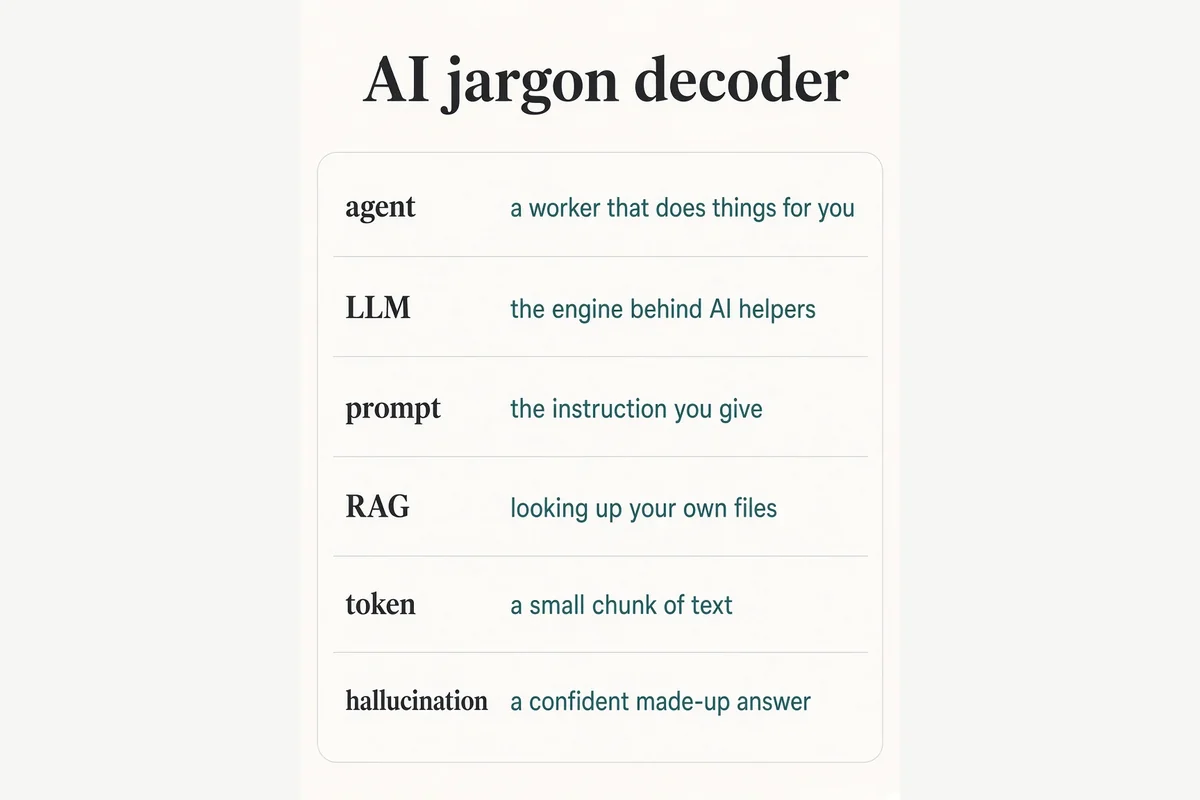
An AI agent is software that does not just answer a question - it works toward a goal. You tell it to reconcile the invoices, and it figures out the steps, uses your tools, checks its work, and reports back. A chatbot replies; an agent does.
What it means for your company: An agent can take over a whole routine that currently eats a person's afternoon - data entry, follow-ups, report prep - on its own. This is where your time comes back. Learn more
AI Avatar
An AI avatar is a digital version of a person - often a video of a real or generated face that can speak your words. For a solo operator, it is a way to put a face on your content without filming every time.
What it means for your company: It lets you produce video that looks like you talking, at scale, without the camera time. Useful for explaining ideas to clients or doing short educational clips. Learn more
AI Overviews
AI Overviews are the short, AI-written answer boxes Google now puts at the top of many searches, right above the normal links. They pull a direct answer from one or more pages and summarize it.
What it means for your company: If your page contains a clean, quotable answer, there is a good chance Google's AI reads it back to the person searching. That is free placement - but only if your answer is written plainly enough to be quoted.
AI Policy
An AI policy is a short written set of rules for how your people may - and may not - use AI at work. What they can put in, what they cannot, and who has to review what.
What it means for your company: One page of rules now saves you a much bigger conversation later - and it is often the first thing a client or a partner asks once they learn you use AI.
AI-Ready Website
An AI-ready website is structured so search engines and AI tools can read it cleanly - clear headings, ordinary text instead of pictures of text, accurate metadata, and the small bits of structured data that tell the machines what each page is about.
What it means for your company: If your site is not AI-ready, you are invisible to the AI search tools your buyers are already using. It is a real, fixable advantage. Learn more
Answer Engine Optimization (AEO)
AEO is the practice of writing a page so that AI answer engines - Google's Overviews, ChatGPT, Perplexity - can lift a short, accurate answer straight off it.
What it means for your company: When a potential client asks an AI what a term means, and your page gets read back as the answer with your site cited, that is reputation you did not pay for. Learn more
Application Programming Interface (API)
An API is the standard, documented doorway one piece of software uses to talk to another. Hand it a request in the right format and it gives back a result - no one needs to know how the other program works inside.
What it means for your company: Every integration your firm relies on - your CRM talking to your email, your bookkeeping talking to your bank - runs through APIs. When AI connects to your tools, this is the door it walks through.
AI Assistants (ChatGPT, Claude, Gemini)
AI assistants are the ready-made helper apps - ChatGPT, Claude, Gemini, and others - that sit on top of a large language model so you can just type and get an answer. They are the friendly front door to the model underneath.
What it means for your company: These are the tools you and your people are already using. The skill is in how you ask and how much you trust the answer - think of them as a very fast, very confident intern, not a free final answer.
Automation
Automation is using software to do a task that used to need a person, on a trigger or a schedule, every time, without you thinking about it. Reports that build themselves, invoices that send themselves, follow-ups that go out on their own.
What it means for your company: The dull, repeatable slice of most jobs is exactly what automation exists to take off your plate. It is the cheapest win in AI.
B
Business Metric / ROI
ROI (return on investment) is simply what you get back compared with what you put in. For AI, measure it in hours saved, errors avoided, or revenue gained versus what the tool costs you.
What it means for your company: Before you buy any AI, decide in one sentence what it has to return to you. If you cannot say it, you are not ready to sign. Run the scorecard
C
Chatbot
A chatbot is a program that holds a text conversation with a person. On your website it answers questions and points people in the right direction. The good ones these days are far more flexible than the old scripted pop-ups.
What it means for your company: A chatbot can answer the ten routine questions every client asks - hours, pricing, how to start - at 2 a.m., so your people only handle the calls that actually need a human.
Context Window
The context window is how much information an AI model can hold in mind at once - everything you have typed, plus any documents you asked it to consider. It is like a short-term memory, measured in tokens.
What it means for your company: A bigger window means the AI can handle a full contract, a whole transcript, or a large spreadsheet in one pass. If your work involves long documents, this number matters.
D
Data Privacy
Data privacy is the set of rules and practices that keep the information you give an AI tool from being seen, kept, or reused by the wrong parties. Who can see it, where it is stored, and what it is used for afterwards.
What it means for your company: The rule most firms get wrong: nothing confidential goes into a public AI tool. One careless paste of a client list or a contract can leak something you cannot afford to leak.
Done-for-You Implementation
Done-for-you implementation means you do not build or set up the AI yourself - a team designs, installs, and wires it into your business for you, then hands you the keys.
What it means for your company: You get the payoff without the learning curve. If your goal is the outcome, not the hobby, this is often the faster and surer route. Learn more
F
Fine-Tuning
Fine-tuning is taking an already-trained general AI model and giving it extra practice on your specific kind of examples so it gets better at your kind of task. Like hiring someone who knows the basics and training them on your filing system.
What it means for your company: Most businesses never need it - off-the-shelf models handle ordinary work fine. It earns its keep only when you have a high-volume, very specific task the general model keeps getting wrong.
G
Generative AI
Generative AI is the kind of AI that creates new content - text, images, code, audio - instead of just sorting or analyzing what it is given. Everything that writes an email or drafts a proposal for you is generative.
What it means for your company: This is the AI your people are already quietly using to draft and design. The question is not whether to adopt it; it is whether you adopt it with rules or without.
Guardrails
Guardrails are the rules and limits you build around an AI system so it stays inside the lines - what data it is allowed to see, what actions it is allowed to take, and what a human has to approve before anything irreversible happens.
What it means for your company: An AI with no guardrails is a worker with no manager. A few rules turn it from a risk into a reliable employee. Find the gaps
H
Hallucination
A hallucination is when an AI states something with total confidence that simply is not true - a wrong fact, a made-up citation, a plausible-sounding number that does not exist. It is not lying on purpose; it is filling a gap with its best guess.
What it means for your company: Never let AI be the final word on anything critical without a human check. The answer will sound certain. Certain is not the same as correct.
Human in the Loop
Human in the loop means a real person reviews or approves what the AI produces before it is final - especially for anything important, expensive, or visible. The AI drafts; the human decides.
What it means for your company: This is the safest way to start with AI: let a machine do the routine part and keep a person on the final call. You get the speed and keep the judgment.
I
Integration
An integration is a connection that lets two separate software systems work together automatically - your CRM feeding your email tool, your accounting pulling from your bank. Most run through an API.
What it means for your company: Integrations are how AI stops being a separate app you visit and starts living inside the tools you already use every day. That is where the real efficiency lives.
L
Large Language Model (LLM)
An LLM is the engine behind modern AI helpers - a program trained on enormous amounts of text that has learned to predict the next word so well it can write, summarize, explain, and reason. Large refers to the huge number of examples it trained on.
What it means for your company: When a vendor says our AI, they almost always mean an LLM under the hood. It is the talented writer; the software around it is how you put it to work in your business.
llms.txt
Llms.txt is a small, simple text file you can put on your website that tells AI bots what your site is about and which pages matter most. It is a cheat sheet for the machines that now summarize and answer for your customers.
What it means for your company: It is a tiny, free file that helps AI tools describe your business the way you want - instead of the way they guess. Set one up
M
Machine Learning (ML)
Machine learning is the broad class of AI where a program gets better at a task by studying examples instead of following hand-written rules. It spots patterns in your data and uses them to predict what comes next.
What it means for your company: This is the quiet workhorse behind flagging unusual invoices, guessing which email a lead will open, or predicting which client is about to churn - the patterns a busy person never has time to see.
Model
A model is the trained brain of an AI system - the result after a program has been fed enough examples to get good at its task. Every AI tool you use is powered by a specific model underneath.
What it means for your company: Which model is it running? is the most useful question you can ask any AI vendor. It tells you the quality, speed, and cost you are really getting.
P
Pilot
A pilot is a small, time-boxed test of AI on one real task in your business - run it for thirty days on one process, measure whether it actually helps, then decide whether to scale it. Not a full rollout, not a science project.
What it means for your company: Pilots are how smart firms adopt AI without betting the business. One narrow win, proven, then grow from there.
Prompt
A prompt is the instruction you give an AI model - what you want it to do, the context it needs, the format you want the answer in. The quality of what comes out starts with how you frame what goes in.
What it means for your company: A vague prompt gets you a vague answer. Tell the AI who it is writing for and what you will do with the result, and the output improves immediately. It is a skill, and it is learnable. Try it: 10 copy-and-paste AI prompts for business owners.
Prompt Injection
Prompt injection is a trick where someone hides instructions inside text an AI is reading - an email, a webpage, a document - that get the AI to do something its operator never intended.
What it means for your company: It matters when an AI has access to real systems or money. It is a security issue, not a parlor trick, and it is part of why monitored AI matters. Check your AI
Prompt Template
A prompt template is a saved, reusable prompt with blank spots you fill in each time. Instead of rewriting the same instructions every morning, you keep the structure and drop in the new information.
What it means for your company: Templates are how a good way of working becomes your standard way of working - the same reliable output every time, without your people reinventing the wheel daily.
R
Retrieval-Augmented Generation (RAG)
RAG is a technique where an AI first looks up the relevant parts of your own documents, then answers based on what it found - instead of just answering from its general memory. It is how an AI gives accurate answers about your business specifically.
What it means for your company: This is the difference between an AI guessing and an AI quoting your actual files - your policy, your prices, your procedures. When a vendor says the AI knows your data, RAG is usually how.
S
Shadow AI
Shadow AI is AI software your people use at work that IT and leadership do not know about - the free chatbot they paste client details into, the tool they adopted on their own.
What it means for your company: Shadow AI means your team is already using AI, just unmanaged and unprotected. The fix is not to ban it (they will just hide it); it is to bring it into the light with rules. Find and tame it
Structured Data / Schema
Structured data (or schema) is a standardized format coded into a webpage that tells search engines and AI tools exactly what the content is - a definition, a person, a set of questions. It is metadata that reads like an instruction sheet.
What it means for your company: It is how you hand Google and the AI engines the answer on a plate instead of making them guess. This page uses it so its definitions get quoted correctly. Build an AI-ready site
T
Token
A token is a small chunk of text an AI reads and writes - roughly a piece of a word, occasionally a whole short word. Models are priced and limited by how many tokens you use.
What it means for your company: Tokens are the gallons of AI - they set both the cost and how much you can process at once. A quick sanity check on tokens tells you what a big task will really cost.
Training Data
Training data is the enormous collection of publicly available text and code a model is shown during development so it learns how language and knowledge work. It is the raw material that becomes the model's brain.
What it means for your company: It is why a model can be brilliant on public topics and confidently wrong about your internal specifics - it only knows what it was trained on, not what is private to you.
V
Voice Agent
A voice agent is AI that talks on the phone - answers calls, books appointments, takes messages in a natural-sounding voice. It is the next step past a text chatbot.
What it means for your company: For a firm that misses calls or pays someone to answer them, a voice agent can turn every missed ring into a booked meeting.
W
Workflow
A workflow is the fixed sequence of steps a task moves through - from request to approval to finished output. When you hear AI workflow, it means the AI is running those steps, with rules and handoffs between them.
What it means for your company: The biggest wins come from automating whole workflows, not single tasks. Map the routine, then let the machine run the steps.
Common AI questions, plain answers
What is an AI agent?
An AI agent is software that does not just answer a question - it works toward a goal. You tell it to reconcile the invoices, and it figures out the steps, uses your tools, checks its work, and reports back. A chatbot replies; an agent does.
What is an LLM (large language model)?
An LLM is the engine behind modern AI helpers - a program trained on enormous amounts of text that has learned to predict the next word so well it can write, summarize, explain, and reason.
What is RAG (retrieval-augmented generation)?
RAG is a technique where an AI first looks up the relevant parts of your own documents, then answers based on what it found - instead of just answering from its general memory.
What is a hallucination in AI?
A hallucination is when an AI states something with total confidence that simply is not true.
What is a prompt?
A prompt is the instruction you give an AI model - what you want it to do, the context it needs, the format you want the answer in.

Mark Yegge
CEO of a Wall Street firm 1993-2005, sold to a top New York bank. Today he uses AI across his own businesses before teaching owners what works.
See every way to work with Mark
Whether you want to learn it yourself, have it built for you, or hand the technical layer to a team while you run the business - there is a path that fits.
$297 AI Challenge - first live session Tuesday, December 8, 7 PM ET.